3-way matching for CAS firms is the process of verifying every client invoice against a purchase order and a delivery receipt before approving payment. This single control separates advisory-level CAS engagements from commodity bookkeeping.
TL;DR
1. One control, three documents. Every payment requires a matching PO, delivery receipt, and invoice — before a single dollar moves.
2. Manual AP costs SMBs 15–20 staff hours per month just to process 150 invoices. That does not include the approvals no one documented.
3. Coast cut invoice processing time by 30% — by reviewing exceptions only, not every invoice.
4. myDNA closed the books in 3 days instead of 8 — because the data was already clean when month-end started.
5. Ghost vendors and inflated invoices stop here. Fraud now requires three matching fake documents, not one.
6. Every payment generates a permanent, timestamped audit trail automatically. No reconstruction at year-end.
7. CAS firms are live in 2–4 weeks. The billing conversation shifts from processing hours to financial protection.
Introduction: Two Types of CAS Firms
There are two kinds of Client Advisory Services firms in the market right now.
The first kind handles the work. They process invoices, reconcile accounts, and close the books on time. They are competent and reliable. They are also, unfortunately, replaceable, because the work they do looks a lot like what their competitors do.
The second kind designs the controls. They implement 3-way matching for CAS clients, build procurement workflows, and hand the CFO a clean audit trail at the end of every month. When an auditor walks in or a board asks for documentation, these firms make their client look organized, even if the client’s internal team never thought about audit readiness once.
The difference between the two is not headcount or software spend. It is one process: 3-way matching.
Firms that implement automated 3-way matching for their clients are not doing more bookkeeping. They are doing something the client cannot easily replicate on their own. They are building a financial control system that catches fraud before it happens, eliminates duplicate payments, and turns the month-end close from a scramble into a routine.
This article explains how to get there. We also cover how tools like ProcureDesk give CAS firms the infrastructure to deliver this kind of service at scale, across multiple clients, without adding staff.
What Is 3-Way Matching and How Does It Work for CAS Firms?
Before getting into strategy, it helps to define exactly what 3-way matching is, because the term gets used loosely.
3-way matching is the process of comparing three documents before approving an invoice for payment:
- The Purchase Order (PO) — This is the authorization. It confirms that someone at the company approved a purchase before the money moved.
- The Goods Receipt (or Delivery Confirmation) — This is the proof of fulfillment. It confirms that what was ordered actually arrived, in the correct quantity and condition.
- The Vendor Invoice — This is the payment request. It needs to match both of the above documents before it gets paid.
The logic is simple: if the PO says you ordered 100 units at $50 each, and the receipt confirms 100 units were received, and the invoice bills for 100 units at $50 each, the invoice is valid and can be paid. If anything does not match, the system flags it for review.
This sounds straightforward. In practice, most SMB clients are not doing it. They are paying invoices based on whether an email thread looks familiar or whether the vendor is someone they recognize. That is not a control. That is trust, and trust is not auditable.
A quick note on 2-way matching: Not every purchase involves a physical delivery. When a client buys consulting services, legal work, or software subscriptions, there is no goods receipt to capture. For those invoices, 2-way matching applies: the PO and the invoice are compared directly, without a receipt document. A well-configured system handles both types automatically, applying the right matching rule based on how the purchase was categorized.
For a deeper breakdown of when each applies, see our guide on the invoice matching process.
For CAS firms, the opportunity is clear. Your clients need this process for both tangible purchases and services. Most of them do not have it either. And without the right tools, building it manually across a dozen or more client accounts is not realistic.
The Hidden Cost of “Stitch-and-Fix” Reconciliation
Most CAS firms that are not yet running automated matching are doing what is politely called “exception management.” They review invoices, chase down POs, send emails to warehouse staff asking whether a shipment came in, and eventually approve the payment a few days later than they should have.
This is “stitch-and-fix” reconciliation. It works, technically. But it costs more than clients realize, and it creates risk that accumulates quietly over time.
Consider what the manual process actually requires:
- An AP staff member receives an invoice and manually looks up the corresponding PO.
- They email or call the person who placed the order to confirm delivery.
- They update a spreadsheet to track matching status.
- They route the invoice to an approver via email.
- If the approver is out, the invoice sits.
- If the invoice has a discrepancy, it goes back to the vendor, and the cycle repeats.
For a client processing 150 invoices per month, this process can consume 15 to 20 hours of staff time every single month. And that is a conservative estimate for a moderately organized team. Many clients spend far more.
The invoice approval workflow does not just eat time. It creates gaps in the audit trail. If an approver approved an invoice via a text message, or a purchase was authorized verbally before a PO was ever created, the documentation does not exist when an auditor asks for it.
That is the real cost of manual reconciliation: not just hours lost, but controls that were never enforced in the first place.
Pro-Tip: When onboarding a new CAS client, ask them this one question: “When an invoice arrives, how do you verify it matches what was ordered and what was received?” The answer tells you everything about where their AP process actually stands.
If you want to see how ProcureDesk handles the full matching workflow across multiple client accounts, schedule a 20-minute walkthrough here. We will show you exactly how the exception routing works before you commit to anything.
The “Exception-Only” Workflow: What Automation Actually Changes
The goal of 3-way matching automation is not to eliminate human judgment. It is to eliminate human judgment from the transactions that do not need it.
When a three-document match is perfect, a system should be able to approve the invoice without anyone having to touch it. When there’s a discrepancy, a human needs to get involved. Automation routes each invoice to the appropriate outcome.
In practice, the vast majority of invoices for a well-run client will match cleanly. Coast, a ProcureDesk customer, documented a 30 percent reduction in time spent on invoice processing after implementing automated 3-way matching. The driver was the same in their case as in most: the team stopped reviewing every invoice and began reviewing only those that needed attention.
Your team’s attention shifts to the invoices with price variances, missing receipts, or quantity mismatches. That is where the actual financial risk lives.
This creates a fundamentally different workflow for CAS teams:
Before automation: Every invoice requires someone to pull up a PO, check quantities, and manually approve or escalate.
After automation: The system handles clean matches. Your team reviews only the exceptions. Everything else clears automatically and moves to payment.
The paperless invoice approval system also routes exceptions to the right person automatically. If a receipt is missing, it goes to the person who placed the order. If a price is off, it goes to the buyer or vendor contact. No one has to figure out who to email. The workflow handles it.
This is the shift that high-end CAS firms are making: from processing invoices to managing exceptions. It is a fundamentally higher-value activity, and it positions your firm very differently in the client’s eyes.
3-Way Matching as “Proof of Competence”
Here is the insight that most CAS firms miss: 3-way matching is not just an efficiency tool. It is a credibility signal.
When a CFO or board member sees that every payment has a corresponding PO, a delivery confirmation, and a matched invoice, they are not just looking at clean books. They are looking at evidence that someone built a system of controls. That is a very different thing from “the accountant kept good records.”
The Fraud Barrier
Vendor fraud is more common in SMBs than most finance leaders want to admit.
According to the ACFE’s 2024 Report to the Nations, billing schemes alone account for 22 percent of all occupational fraud cases with a median loss of $100,000 per incident and more than half of all fraud cases trace back directly to a lack of internal controls or an override of existing ones, making documented procurement controls one of the most cost-effective risk management tools available to SMB finance leaders.
Ghost vendors, inflated invoices, and duplicate billing are all significantly harder to execute when 3-way matching is in place.
The reason is straightforward: a fraudulent invoice requires three matching documents, not one. Creating a fake invoice is easy. Creating a fake PO that matches it, and a fake receipt that confirms delivery, is much harder. The control breaks the fraud vector at the source.
This protection is not theoretical. For CAS clients in biotech, logistics, and construction, where vendor relationships are complex and purchase volumes are high, it reduces real financial risk every month.
Audit-Ready by Design
The other major credibility signal is audit readiness. When a client’s auditor asks for documentation on a purchase from eight months ago, the answer should not involve searching through email inboxes and spreadsheet exports.
With automated 3-way matching and a proper procurement compliance framework, every transaction has a permanent, timestamped digital record: who approved the PO, when the delivery was confirmed, and when the invoice was matched and paid. The audit trail is not assembled at year-end. It is built automatically with every transaction.
This changes the audit experience for your clients. It also changes how they perceive the value of your firm. If your firm is the reason their audit went smoothly, that is not a commodity service. That is strategic protection.
The “Advisory Moat”
There is also a retention argument. When a CAS firm manages a client’s full procure-to-pay workflow, they become embedded in the client’s operations in a way that a basic bookkeeping relationship does not achieve.
Replacing a firm that processes invoices is straightforward. Replacing a firm that designed and operates the client’s purchasing approval process, vendor controls, and matching workflow requires rebuilding months of institutional setup. The switching cost is real, and it works in your favor.
High-retention CAS practices are almost always ones that have moved upstream from bookkeeping into process ownership. 3-way matching is one of the clearest ways to cross that line.
For CAS firms building their pricing model around process ownership, 3-way matching is typically bundled into a managed AP or procure-to-pay service tier, priced on a per-client or per-entity basis rather than by the hour. Because automated matching reduces staff time on invoice processing, ProcureDesk clients have documented reductions of 30 percent or more in processing time, the service can be priced for value delivered rather than hours billed. Firms that have made this shift report that the control and audit-readiness story is easier to sell at a fixed monthly retainer than line-item bookkeeping work, particularly to CFO-level buyers who are accustomed to paying for outcomes.
Pro-Tip: Use your first client review after implementing 3-way matching to show the CFO a report of flagged exceptions, how many were caught automatically, and what the total invoice dollar value was. This converts a technical workflow into a visible, measurable protection story.
The Accelerated Close: How Matching Changes Month-End
One of the most concrete benefits CAS firms can show clients is the impact on the month-end close time.
The reason close takes so long at most SMBs is not that the accounting is complex. It is that the underlying transaction data is incomplete or unreliable. Invoices arrive without POs. Receipts were never entered. Approvals happened informally and cannot be traced. The close process becomes a cleanup process, and cleanup takes time.
When 3-way matching is running continuously, the close process changes. POs are tied to receipts. Receipts are tied to invoices. Invoices have a full approval history. By the time the month-end arrives, the data is already organized. The close becomes a confirmation process rather than a reconstruction project.
The impact can be significant. myDNA, a genomics company that implemented ProcureDesk’s procure-to-pay automation, reduced its month-end close from 7 to 8 days down to 3 days. The close did not get faster because the team worked harder. It got faster because the data was already clean when they started. There was no reconciliation backlog to work through.
For CAS firms, this is a talking point that resonates immediately with CFO-level buyers. A 3-day close versus an 8-day close is not an accounting improvement. It is a business operations improvement, and it translates directly into time available for strategic planning rather than financial firefighting.
How Do You Implement 3-Way Matching for a CAS Client?
Getting a client from zero to a functioning 3-way match process requires addressing a few upstream problems first. Here is what to address in the right order.
Step 1: Establish a PO Policy
3-way matching only works if every purchase starts with a purchase order. Most SMB clients do not have this. Purchases happen through verbal requests, email chains, or just buying things and submitting the receipt later.
The first step is getting the client to require a PO for every purchase above a defined threshold. The exact threshold depends on the client’s purchase volume and risk tolerance, but the principle is non-negotiable: no PO, no payment. This is the foundation of the entire control system.
A purchase order approval software platform automates the PO creation process so employees do not have to generate POs manually. They submit a purchase request, it gets approved through a defined workflow, and a PO is generated and sent to the vendor automatically. This is not extra work for the client’s team. It replaces the informal process they were already using.
Step 2: Capture the “Invisible” Receipt
The hardest document to obtain in a 3-way match is the goods receipt, also called the GRN (Goods Receipt Note). The PO exists in the system. The invoice comes in from the vendor. But the confirmation that goods actually arrived often lives in someone’s inbox, a paper note in the warehouse, or nowhere at all.
This problem is especially acute in biotech and life sciences. Scientists ordering lab consumables receive those supplies at the bench and return immediately to their work. They do not think of themselves as a “receiving department,” so no GRN gets created. The invoice arrives, and there is nothing to match it against. The AP team either approves blindly or chases the researcher, neither of which scales.
The solution is giving the people who receive goods an easy way to confirm delivery in the system at the moment it happens. For clients with warehouse teams, this means a portal or mobile app they can use at the point of receiving. For distributed teams like lab staff or field crews, it means a mobile-friendly confirmation step that takes under a minute on any device.
ProcureDesk’s mobile-native receiving workflow is built for exactly this. Field staff, lab teams, and warehouse personnel can confirm deliveries and log receipt notes from any device, without logging into a desktop system. This removes the most common bottleneck in the 3-way match process.
Step 3: Automate the Matching and Route the Exceptions
Once POs and receipts are consistently in the system, the matching engine can do its job. Every incoming invoice is automatically compared against its corresponding PO and receipt. Invoices that match within defined tolerances are cleared for payment. Invoices with discrepancies are flagged and routed to the appropriate reviewer.
For CAS firms managing multiple clients, the key is a dashboard that shows exception status across all accounts in one place. You want to see, at a glance, which clients have unmatched invoices, what the variance is, and how long each exception has been sitting open. That visibility is what lets a lean advisory team manage a large client portfolio without getting buried.
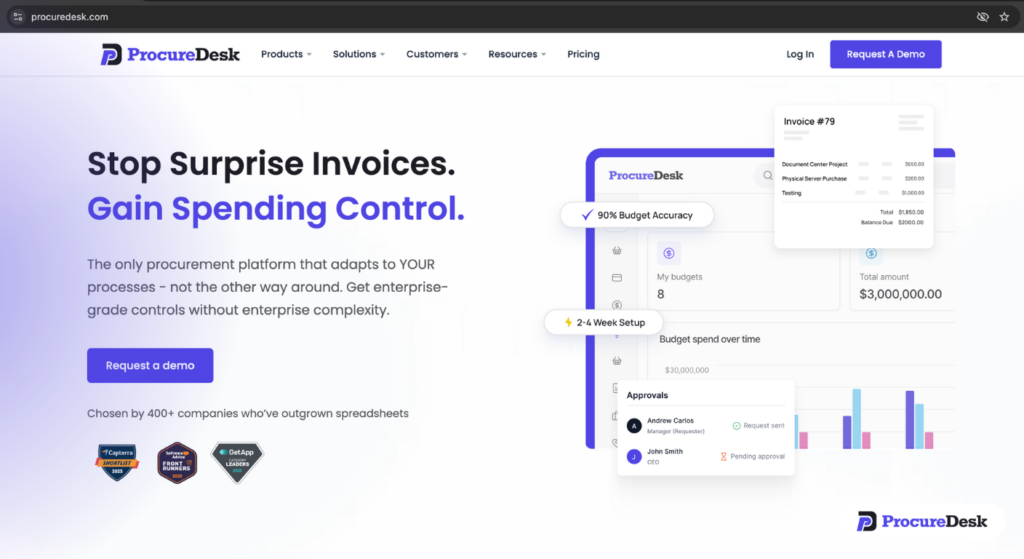
The AP invoice approval workflow software from ProcureDesk provides this exception-based view, along with automated routing rules that direct each exception to the right approver without manual intervention.
Ready to see what automated 3-way matching looks like inside ProcureDesk? Schedule a walkthrough here. We configure the demo around your client’s accounting stack so you can see exactly how the integration works.
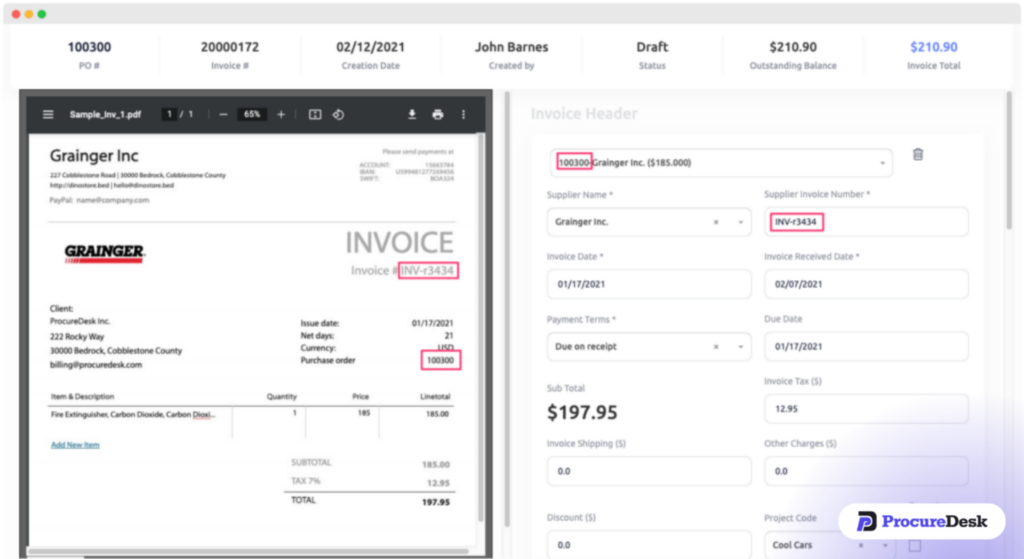
Pro-Tip: Use 3-way matching exception reports to identify which vendors are consistently short-shipping or overbilling your clients. This turns a control process into a vendor management insight, and it is exactly the kind of analysis that justifies an advisory fee rather than a bookkeeping rate.
Step 4: Connect to the Client’s Accounting System
The final step is ensuring that matched and approved invoices sync automatically to the client’s accounting software. Manual data entry between systems reintroduces the exact errors that 3-way matching is designed to prevent.
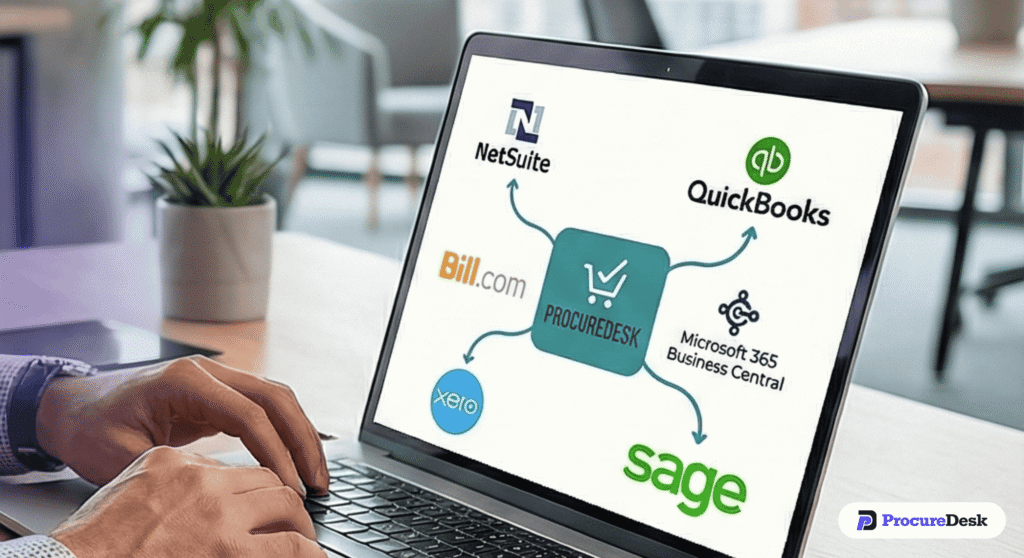
ProcureDesk integrates directly with QuickBooks Online, QuickBooks Desktop, NetSuite, Sage Intacct, Xero, and Microsoft Dynamics 365 Business Central. Approved invoices push to the accounting system in real time. No CSV exports, no rekeying, no reconciliation step at month-end. For a full walkthrough of how the sync works with each platform, see our procure-to-pay system guide.
Common Objections, Addressed
“Our clients won’t adopt a new system.”
The adoption challenge is almost always overstated. For employees making purchases, the process looks like submitting a request through a simple form and clicking “approve” from an email. For the receiving team, it is confirming a delivery on their phone. The complexity lives in the backend configuration, which your firm handles once. Day-to-day, it is simpler than what most clients are currently doing.
“We don’t control our clients’ purchasing decisions.”
You do not need to. The CAS firm’s role is to design the workflow and configure the controls. Purchasing decisions remain with the client. What changes is that those decisions now happen inside a system that documents them automatically. You are not taking over procurement. You are building the infrastructure that makes it auditable.
“We already use QuickBooks for this.”
QuickBooks is an excellent accounting system. It is not a procurement system. It does not enforce PO requirements, manage approval workflows, or perform 3-way matching on incoming invoices. Automating purchase orders requires a layer that sits in front of the accounting system, not inside it. ProcureDesk connects to QuickBooks without replacing it.
Frequently Asked Questions
For a CAS firm, 3-way matching means verifying that every client invoice is supported by a purchase order and a delivery receipt before approving it for payment. The firm manages this process on behalf of the client, either manually or through automation software.
Automated matching creates a permanent digital record for every transaction. When an auditor asks for documentation on a payment, the system can produce the original PO, the delivery confirmation, and the invoice instantly. This eliminates the “we approved it informally” problem that creates audit exposure.
2-way matching compares the vendor invoice against the purchase order only. It is used for service-based purchases where no physical delivery occurs. 3-way matching adds a third document, the goods receipt, and is used for purchases of physical goods. A well-configured system applies the right matching type automatically based on how each purchase was categorized.
ProcureDesk integrates directly with QuickBooks Online, QuickBooks Desktop/Enterprise, NetSuite, Sage Intacct, Xero, and Microsoft Dynamics 365 Business Central. Approved invoices sync in real time, eliminating manual data entry between systems.
As of 2026, most clients are live within 2 to 4 weeks, including workflow configuration, vendor catalog setup, and accounting system integration. ProcureDesk’s team handles the technical configuration, so the CAS firm and the client focus on process decisions rather than software implementation.
ProcureDesk supports multi-entity configurations, which works well for companies with subsidiaries or multiple cost centers within a single account. CAS firms managing several distinct client organizations typically set up a separate ProcureDesk environment per client.
Contact the ProcureDesk team to discuss the right structure for your firm’s specific portfolio setup.
Conclusion: Selling Financial Control, Not Bookkeeping Hours
The CAS market is moving in a predictable direction.
Firms that compete on transaction volume will face continued price pressure as automation handles more of what they do. Firms that design and operate financial controls for their clients will be harder to replace and easier to grow.
There is also a billing model argument. When your firm processes invoices, you bill for the time it takes to process invoices. When your firm owns the client’s procurement controls, the match process, and the audit trail, you are billing for the financial protection you provide and the risk you prevent. That is a fundamentally different conversation, and it commands a fundamentally different rate.
3-way matching is one of the clearest ways to cross that line. It converts a reactive AP function into a proactive control system. It protects clients from fraud. It makes audits manageable. And it gives CFOs the spend visibility they have been asking for since the last time a surprise invoice hit their budget.
The technology to deliver this at scale exists. ProcureDesk gives CAS firms the procure-to-pay automation infrastructure to implement 3-way matching for clients in 2 to 4 weeks, connected to the accounting systems they are already using, without replacing anything.
Want to see how it works across a real client scenario?
Schedule a personalized demo with the ProcureDesk team. We will walk you through the full procure-to-pay workflow, show you how exception routing works, and help you assess which of your current clients are the best fit to start with.