Key Takeaways
- Code at the request, not the invoice. Only the requester knows which grant and property a purchase serves, and that memory fades within days.
- Build coding as separate dimensions: award, fund, property, project, cost category and GL account. You can then report by any one of them without rebuilding your chart of accounts.
- Screen allowability before the order goes out. Prior approval, pre-award timing and equipment thresholds can’t be fixed after the purchase.
- Write down the method behind every split, cost share entry and in-kind valuation when you make the decision. Auditors ask which basis you used and why.
- Check budget against committed spend, not only invoices, so approved orders that haven’t been billed can’t overspend an award. ProcureDesk validates every request against available budget plus committed spend before approval.
Quick Answer
Most teams code grants and properties after the fact. The invoice arrives, goes out for approval, and waits in someone’s queue. By the time the property manager opens it, they can’t remember whether they ordered the item, which grant or property it was for, or whether it was ever received. The coding gets guessed or sent back, and reclasses follow.
Grant and property cost coding works when it moves to the purchase request. The requester picks the award, property and GL account while they still remember the purchase, budget is checked before approval, and the invoice inherits the approved coding. With ProcureDesk, that coding carries through the PO and invoice into your accounting system, and implementation takes 2 to 3 weeks.
That delay is why coding errors pile up. One accountant ends up deciding which grant, fund, property and GL account each invoice should hit, with no easy way to ask the requester what the purchase was for.
A $6,000 item that should have been capitalized as equipment lands in supplies. An invoice that belonged on two awards lands entirely on one, on an award that was already spent. The cost is a month of reclassing journal entries, restated funder reports, and a single audit where you explain coding decisions you can’t fully document.
The same five mistakes cause most of the reclasses and audit findings:
- Coding at the invoice instead of the purchase request.
- Filing equipment under supplies because the capitalization threshold was never written down.
- Charging a split-funded invoice entirely to one award.
- Counting the same in-kind contribution as match on two awards.
- Checking budget at month end, after the money is spent.
The seven steps below prevent all five. They run from structure through allowability, splits, property coding and point-of-request capture to accounting sync, with a coding key and checklist you can copy.
How do you know your cost coding is breaking down?
You have a coding problem when accounting spends close week correcting codes instead of reviewing them. These are the signs we see most often:
- Reclassing journal entries appear every month, and most trace back to the same few award or property codes.
- A requester can’t tell you which program a purchase was for, and the invoice carries no reference.
- You can’t pull spend-to-date for one award or one property in under five minutes without a spreadsheet.
- Budget overruns on an award surface in the funder report, after the money is gone.
- Auditors ask for support on an in-kind valuation or a split allocation, and the method was never written down.
Take a hypothetical. A program coordinator orders $4,200 of tablets for a youth literacy program. The invoice arrives with a vendor name and no program reference, AP codes it to general operations, and the grants manager catches it at quarter end. Reclassing it means a journal entry, a note to the funder and a corrected report.
What is grant and property cost coding?
Cost coding tags every dollar of spend with the dimensions someone will later ask about: which award, which fund, which property, which project, which cost category and which GL account. Grant coding answers “whose money paid for this, and was that allowed?” Property coding answers “which building, site or capital project does this belong to?”
The two overlap constantly. A roof replacement funded by a community development grant has to be coded correctly for the award, the property and the balance sheet at the same time.
Federal awards restrict spend by cost category and budget line under 2 CFR 200, the Uniform Guidance. Foundation and state awards usually copy that structure, then add their own eligible and ineligible lists. On the property side, coding drives capitalization, depreciation, CAM allocations and per-property P&Ls.
Coding is also a compliance control. The Uniform Guidance requires costs and contributions to be verifiable from your own records, so a code with no document behind it creates audit exposure.

ProcureDesk is a procurement and AP automation platform that moves coding to the moment of purchase. Finance teams at nonprofits, municipalities and multi-property operators use it in three ways. They capture the award, property and GL account on the request, check budget before approval, and sync the coded transaction to the accounting system.
See coding at the request, in your chart of accounts
A 20-minute walkthrough on your own grant and property structure.
Step 1: Design your coding structure before you spend a dollar
A good coding structure keeps each question a funder or auditor might ask in its own field. Build separate dimensions instead of one long concatenated account number, so you can report by award, by property or by cost category without rebuilding the chart of accounts.
The minimum set for grant-funded organizations is a grant or award ID, a funding source or fund, a program, a cost category, a GL account and a period. Multi-property and multi-site operators add three more: property or site ID, capital project ID, and a capital-versus-operating flag so improvements don’t get expensed by default.
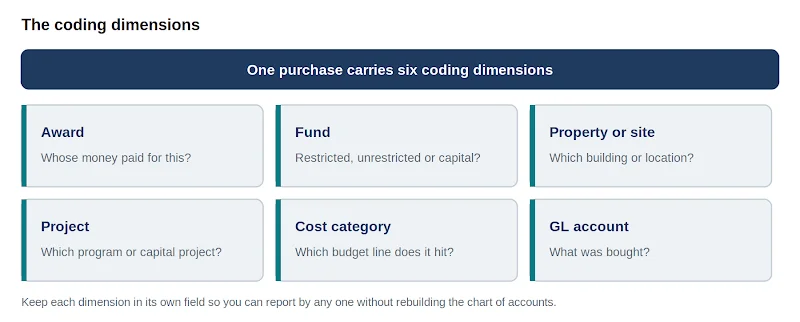
The GL natural account describes what was bought. The grant and property dimensions describe who paid and where it went. Merging them into one field forces a restructure later.
Write a one-page coding key in plain English for requesters, listing each dimension, its valid values, and two or three example purchases per cost category. A requester should be able to pick the right code without calling accounting. Lock codes for closed awards so nothing can be charged to an expired period of performance.
Your ERP sets the vocabulary. Sage Intacct calls them dimensions, NetSuite uses classes, locations and segments, and QuickBooks uses classes, locations and projects. The principle carries across all of them: one field per question.
Step 2: Map federal cost categories to your chart of accounts
Most federal budgets use nine cost categories, and your chart of accounts should map cleanly to all of them. The standard SF-424A budget form lists personnel, fringe benefits, travel, equipment, supplies, contractual, construction, other direct costs and indirect costs. Foundation and state funders usually follow the same list.
The table below is a starting point. Adapt the GL accounts to your own chart.
| Federal category | Typical GL accounts | Example purchases | Coding watch-out |
|---|---|---|---|
| Personnel | Salaries and wages | Program staff time | Needs time-and-effort support tied to timesheets |
| Fringe benefits | Payroll taxes, health, retirement | Employer costs on award-funded salaries | Follows the same allocation as the salary |
| Travel | Travel, lodging, meals | Site visits, conferences | Check funder limits on meals and foreign travel |
| Equipment | Fixed assets, equipment | Servers, vehicles, instruments | Threshold and useful life decide it; prior approval may apply |
| Supplies | Office, program and IT supplies | Laptops under threshold, program materials | Check items priced near the threshold |
| Contractual | Professional services, subcontracts | Consultants, evaluators, repair contractors | Triggers competition and bid documentation |
| Construction | Construction in progress, building improvements | Renovation, new build | Often capitalized; funder rules vary |
| Other direct | Rent, utilities, printing, software | Participant support, license fees | Participant support is usually excluded from the indirect base |
| Indirect | Indirect cost recovery | Applied by rate | Apply automatically off a defined base |
Personnel and fringe require time-and-effort support. Code labor to awards through a payroll allocation tied to timesheets, not a year-end estimate.
Equipment versus supplies turns on your capitalization threshold and useful life. Under 2 CFR 200.1, equipment is tangible personal property with a useful life of more than one year. Its per-unit cost must be at or above the lesser of your own capitalization level or the federal threshold. The 2024 revision raised that federal threshold from $5,000 to $10,000, effective October 1, 2024. If your policy still says $5,000, your policy governs. Some agencies apply the new equipment and subaward thresholds only after your indirect cost rate agreement is updated, so confirm with your agency and award terms. Equipment outside the approved budget may also need prior agency approval, so the code you pick affects compliance as well as reporting.
Contractual covers procured services and carries competition requirements, so coding a purchase there also creates a bid documentation obligation.
Participant support costs and subaward amounts above the first $50,000 are commonly excluded from the modified total direct cost base. Filing them under “other” inflates your indirect recovery and invites a finding. Recipients without a negotiated rate can use the 15% de minimis rate under the 2024 revision, but the base still has to be defined and applied consistently.
Step 3: Screen costs for allowability before the purchase, not after the invoice
A cost is allowable only if it’s necessary for the award, reasonable, allocable to the award that benefits, and not prohibited by statute, regulation or the award terms. Most guidance treats this as a review applied after the fact. It works better as a gate on the purchase request.
Allocable means the award benefits from the cost in proportion to what it’s charged. A defensible split method therefore matters more than a clean-looking round number.
Four items should be flagged at the request stage, because approval obtained after the purchase rarely helps:
- Equipment above your threshold, especially if it isn’t in the approved budget.
- Foreign travel.
- Budget line shifts beyond the variance the funder allows.
- Subaward or scope changes.
Pre-award costs are generally allowable only with written approval and only inside a defined window, so the date of the commitment matters for coding.
Attach a short checklist to every purchase request:
- Which award and which budget line?
- Is there budget remaining on that line?
- Does this need prior approval?
- Was the commitment made inside the period of performance?
- Are the quote, bid or scope document attached?
The grant or program owner should make the final call, and should approve the coding while the purchase can still be stopped or recoded. In ProcureDesk, approval workflows route by amount, department, vendor, GL account, project or custom fields, so the budget owner signs off before the order goes out.
Nonprofit template
Get the template Need a PO policy built for nonprofits? Start from our template.
Step 4: Handle split funding, cost share and in-kind contributions defensibly
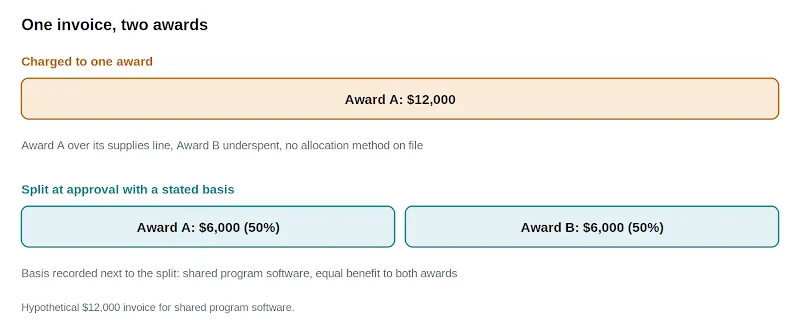
Split a purchase by a stated method and record the method next to the split. Percentage of benefit, headcount, square footage and direct usage are all defensible bases. An auditor will ask which one you used and why.
Allocate by amount when a single line item clearly belongs to one award. Reserve percentage splits for shared costs like facilities or shared staff.
Take a second hypothetical. A $12,000 invoice for shared program software benefits two awards equally. It gets charged to Award A because that’s the code the requester knew, and Award A ends up 8% over on its supplies line by the time anyone checks. Splitting it at approval, with the basis recorded, puts $6,000 on each award and leaves a method on file.
Cost share follows its own rules under 2 CFR 200.306. Contributions can be cash or in-kind from you, a subrecipient or a third party. They must be verifiable in your records, allowable, necessary and reasonable, and not counted toward any other federal award. Under 200.306(b)(2), a contribution can’t be counted toward any other federal award. Under 200.306(b)(5), costs paid by another federal award can’t count as match unless the program’s own statute says they can.
Keep these valuation rules on your coding key:
- Donated professional services are valued at the rates you’d ordinarily pay for similar work.
- Donated equipment and supplies are valued at fair market value at the time of donation.
- Donated space is limited to the fair rental value of comparable space.
- Donated land and buildings are valued at fair market value established by an independent appraiser.
Keep the derivation in writing. Say a food bank uses a partner’s warehouse for six months and the partner’s letter describes the space but gives no rate. Before the entry counts as match, pull three comparable local rental rates and attach them to the record. Costs financed with program income generally don’t count as match unless the award terms say so.
Step 5: Code property and capital purchases correctly
Every property-related purchase needs three decisions: which property, repair or improvement, and whether a grant is funding it. Answer them in that order.
Repairs that maintain existing condition are expensed. Improvements that extend useful life, add capacity or adapt the asset to a new use are capitalized to the building or a capital project code.
Grant-funded improvements need both codes. The funder tracks the budget line, and your balance sheet tracks the asset and its depreciation. Without the award code the funder report is wrong. Without the asset code the fixed-asset register is.

Local and CRA-style grant programs often reimburse a fixed share of eligible project costs, exclude specific items, and require multiple licensed-contractor bids. Put each program’s eligible and ineligible lists in your coding key. Reimbursement programs typically won’t pay for work started before written approval, which makes the PO issue date a coding fact.
Property-restricted awards can carry use and disposition conditions for a set number of years. Tag the asset with its funding source at acquisition instead of trying to trace it at disposal.
Affordable housing operators code across many properties and entities. Aeon is a Minneapolis nonprofit with 58 properties and more than 5,000 apartments and townhomes. Before it would consider a procurement tool, it required entity and dimension capture tied to its Sage Intacct location codes. A landscaping invoice coded to the wrong property lands in the wrong P&L, and often the wrong legal entity.
Rollout guide
Read the guide Rolling out POs across properties? Follow the 7-step plan.
Step 6: Capture coding at the purchase request
Coding is most accurate when the request is raised and least accurate when the invoice arrives. At the request, the requester knows the program and property. Six weeks later, the requester often can’t say. We call the practice of coding at that first moment Requisition-First Coding.
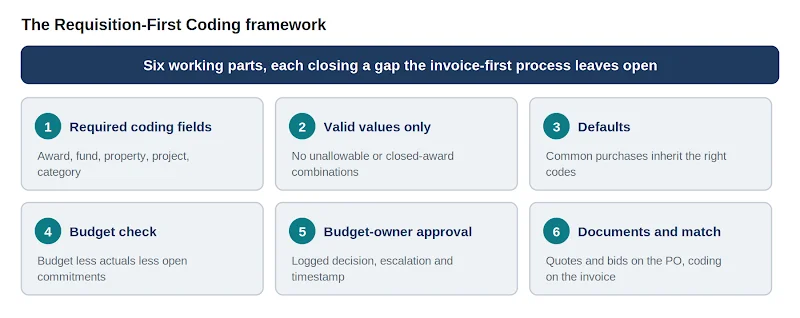
Six working parts make it work:
- Required coding fields. Award, fund, property, project and cost category are required on the request, so nothing reaches approval uncoded.
- Valid values only. Configure lists so a requester can’t select a closed award or an unallowable combination.
- Defaults. Per-award and per-property defaults let common purchases inherit the right coding without the requester learning the chart of accounts.
- A budget check before approval. Budget less actuals less open commitments, so an approved order counts as spent money.
- Approval by the budget owner. The person who owns the grant or property budget signs off while the coding can still change.
- Documents and inherited coding. Quotes and bids sit on the PO, and the matched invoice picks up the coding that was approved.
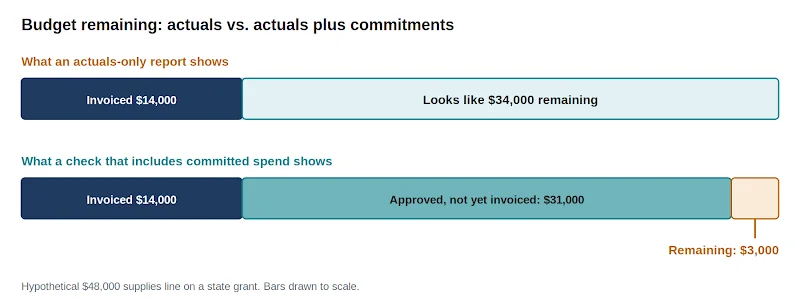
The budget check changes what a manager sees. A program holds a $48,000 supplies line on a state grant. Finance has invoiced $14,000, and three approved requests totaling $31,000 haven’t been invoiced yet. A report built on actuals shows $34,000 remaining. A check that includes committed spend shows $3,000, so the fourth request goes to the budget owner for a conversation before the order goes out. The figures here are hypothetical.
Step 7: Sync coded transactions to your accounting system and report by grant and property
Coding only pays off if it reaches the general ledger intact. The procurement record and the accounting system should share one set of dimension values, not two lists that drift apart.
Rekeying coded invoices is where most coding errors enter, since every manual entry is a chance to transpose an award ID.

Track budget less actuals less open commitments on every award. An end-of-award overspend then shows up months earlier.
With coding intact end to end, reporting by award, funding source, property or capital project takes minutes, including funder reports, drawdown requests and single audit schedules. If you’re a federal awardee, the single audit threshold rose from $750,000 to $1,000,000 in federal expenditures. The change applies to fiscal years beginning on or after October 1, 2024, so confirm whether you’re now under it.
Run one exception report weekly: transactions missing coding, transactions coded to closed awards, and invoices with no matching PO.
How ProcureDesk helps with grant and property cost coding
ProcureDesk is a procurement and AP automation platform for mid-market finance teams. Its setup maps to the steps above, and implementation takes 2 to 3 weeks.
Coding on the request. ProcureDesk’s purchase requisition software assigns accounting codes and user defaults automatically and syncs your chart of accounts, cost codes and departments from your ERP. Requesters work from the same codes the ledger accepts.
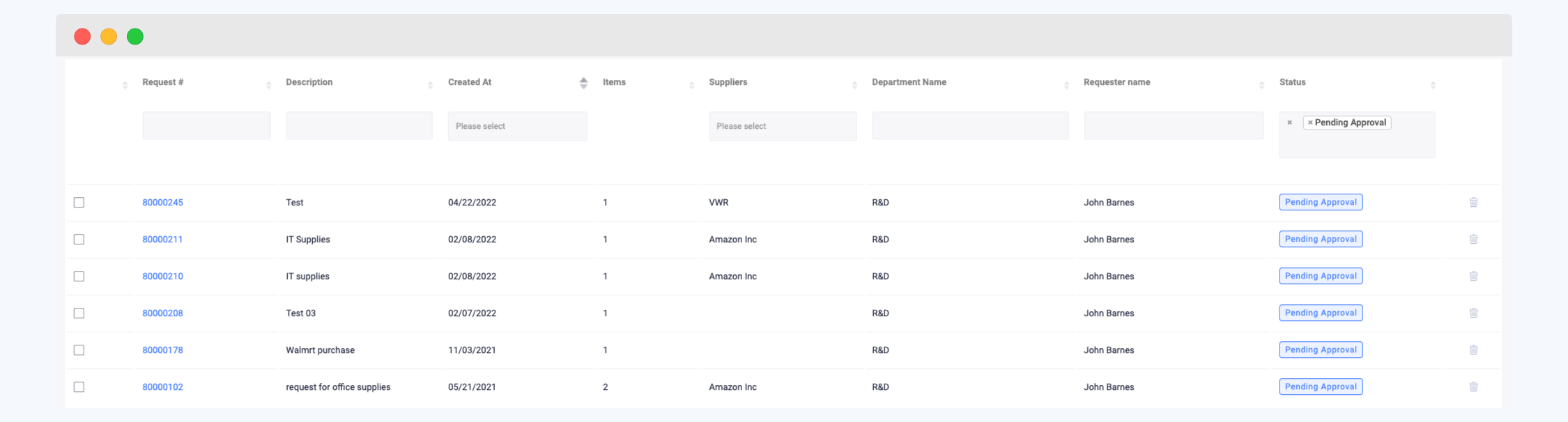
Budget checks against committed spend. Every purchase request is validated against available budget, and the check counts committed spend plus the new request. Budgets can be organized by department, project, GL code or cost center, as described in our proactive budget control overview. For nonprofits, ProcureDesk tracks spend against multiple grant budgets in real time, with audit-ready reporting for grantors, as covered on the nonprofit procurement page.
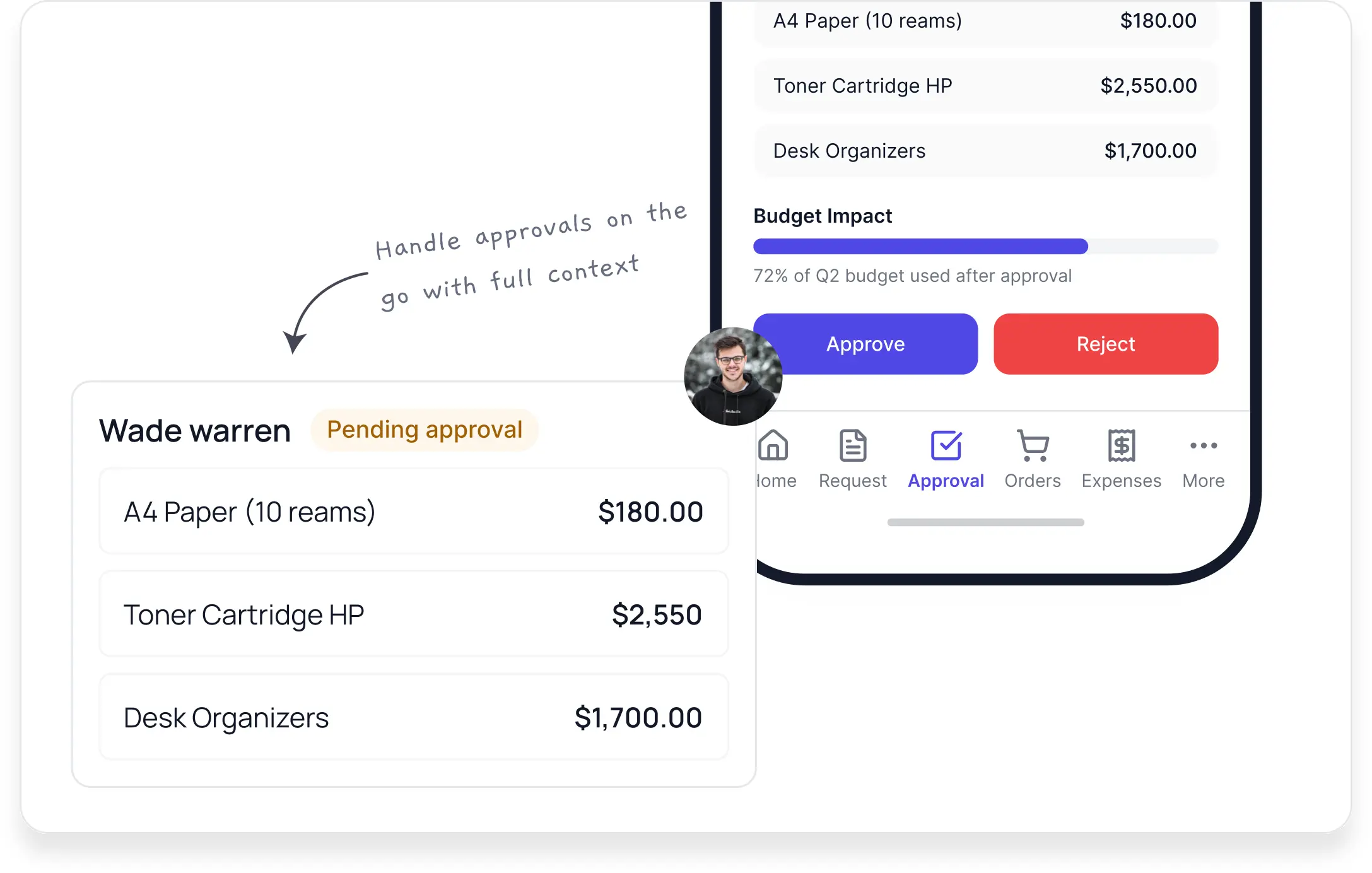
Approval routed to the budget owner. Approval workflows route by amount, department, vendor, GL account, project or custom fields, with parallel sign-offs, sequential chains and conditional logic. Every decision, escalation and timestamp is logged, so you hand auditors a history instead of searching email.
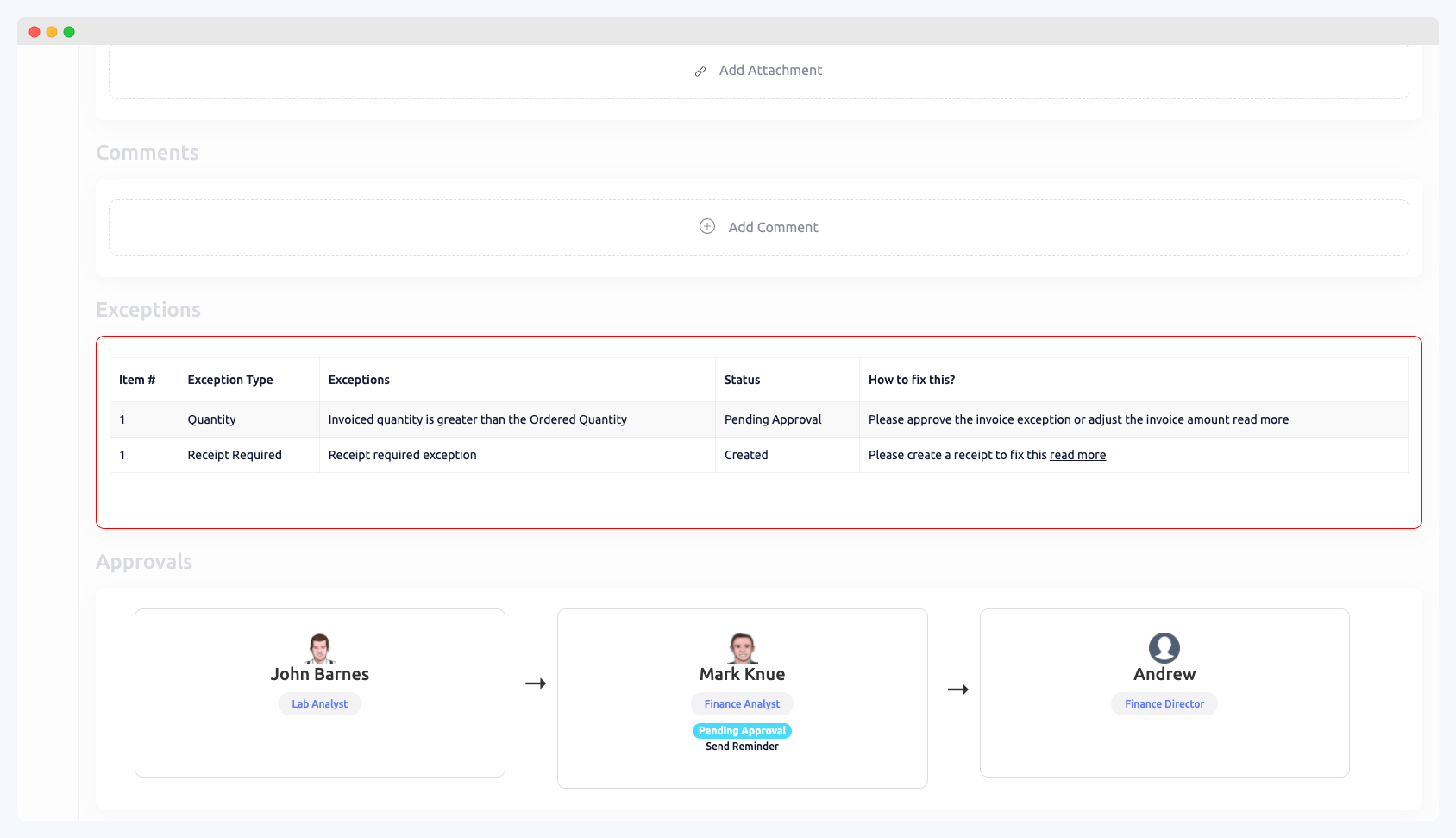
Three-way match carries the coding forward. With three-way match, the invoice is matched to the PO and receipt. The coding approved on the request carries through to the bill instead of being entered a second time. Coding can be assigned at the line level, so a shared invoice can land on different properties line by line. Our guide to invoice coding automation for property management walks through a landscaping invoice split across three properties.
Accounting sync. ProcureDesk integrates with QuickBooks Online, QuickBooks Desktop and Enterprise, NetSuite, Sage Intacct, Microsoft Business Central, Xero and Bill.com. With Sage Intacct, dimensions sync automatically and can be assigned at each invoice level. The NetSuite integration imports the chart of accounts, suppliers, payment terms, classes and locations.
What this looks like in practice: Aeon
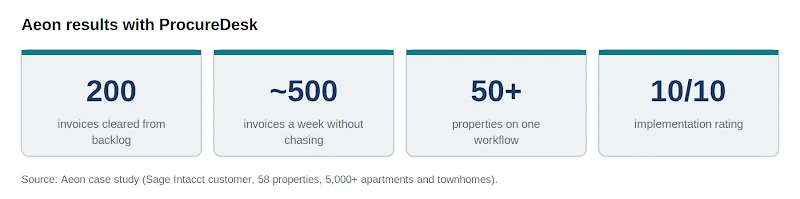
Aeon runs 58 properties and more than 5,000 apartments and townhomes in Minnesota on Sage Intacct. It had three requirements it wouldn’t drop: entity and dimension capture for its Intacct location codes, multi-step approvals with two to four approvers depending on type and amount, and a deep two-way ERP integration. About 100 to 200 of its roughly 500 weekly invoices were sitting in approval queues.
After ProcureDesk went live, the 200-invoice backlog cleared, and about 500 invoices a week now move without anyone chasing approvers, across more than 50 properties on one workflow. Controller Greg Stegman rated the implementation 10 out of 10 and said: “I would have to pry with a crowbar to get ProcureDesk out of our team’s hands right now.”
What this looks like for grant reimbursement: El Hogar
El Hogar Community Services, a nonprofit established in 1977, works under cost-reimbursement contracts with its County, so fast expense visibility decides how quickly it can claim reimbursement. Purchases were requested by email and mostly settled by credit card, which made it hard to tell what was planned, approved or placed.
After moving to ProcureDesk, its approval cycle dropped by more than 50%. Program directors now approve about 80% of purchases at the program level instead of routing them through the CEO. The team went live in 2 to 3 weeks. Fiscal Director Beatrix Koev describes the result as “audit-proof approval process.”

Watch a coded request get budget-checked and approved
Required fields, budget check and routing, start to finish.
Grant and property cost coding checklist and templates
Six job aids cover most of what requesters and reviewers need. The first is the requester coding key, a one-page list of each dimension, its valid values and example purchases. A starter layout:
| Dimension | Valid values | Example |
|---|---|---|
| Award | Active award IDs only | FED-2026-014 |
| Fund | Restricted, unrestricted, capital | Restricted |
| Property or site | Your property list | Maple Court |
| Project | Capital or program project IDs | Roof-2026 |
| Cost category | The nine federal categories | Contractual |
| GL account | What was bought | Repairs and maintenance |
The other five:
- Pre-purchase allowability checklist: award, budget line, remaining budget, prior approval, competition and documentation, as in Step 3.
- Cost category mapping table: the nine federal categories mapped to your GL accounts, as in Step 2.
- Split allocation worksheet: records the allocation basis next to the percentages, so the method is documented when the decision is made.
- Capitalize-versus-expense decision tree: your threshold and useful-life rules filled in, starting from the diagram in Step 5.
- Month-end coding review list: unmatched invoices, transactions on closed awards, missing attachments, and budget-line variances approaching the allowed threshold.
Frequently asked questions about grant and property cost coding
What’s the difference between allowable, allocable and reasonable costs?
Allowable means the cost is permitted by the award terms and cost principles. Allocable means the award benefits in proportion to what it’s charged. Reasonable means a prudent person would have paid that amount in the same circumstances.
What’s the difference between direct and indirect costs on a grant?
Direct costs can be tied to a specific award, such as program staff, program supplies or a contractor working on that program. Indirect costs are shared across the organization, such as rent, accounting or IT. They are recovered through your negotiated rate or the 15% de minimis rate, applied to a defined base. Code direct costs to the award at the request, and let the indirect rate apply off the base.
Can one invoice be charged to two grants?
Yes, when each award benefits from the purchase and the allocation method is documented and applied consistently. Record the basis (percentage of benefit, headcount, square footage or usage) at the time of the split.
Can grant funds be used to meet another grant’s match requirement?
Generally no. Under 2 CFR 200.306(b)(5), federal funds from another award can’t count as cost share unless the program’s federal authorizing statute specifically allows it. Check the statute and the award terms first.
When does a purchase need prior approval?
Typically for equipment not in the approved budget, foreign travel, budget shifts beyond the variance the funder allows, and changes in scope or key personnel. The award terms control, so confirm the specific conditions before you order.
Should a grant-funded building improvement be capitalized?
Usually yes, if it extends useful life, adds capacity or adapts the asset to a new use. It still needs the award code alongside the asset code so the funder’s budget line and your fixed-asset record both stay accurate.
What’s the equipment threshold for federal awards?
Equipment is property with a useful life over one year and a per-unit cost at or above the lesser of your capitalization level or $10,000. The federal figure was $5,000 before October 1, 2024.
How long do I need to keep coding records?
The general federal rule is three years from the date you submit the final financial report, and longer if the award terms, an audit or litigation require it. Check your specific award before you purge anything.
Who should own coding, accounting or the program team?
Program owners choose the award and property because they know the purpose of the purchase. Accounting owns the coding structure and the review. This also removes the bottleneck of one accountant coding everything.
How does ProcureDesk help with grant and property cost coding?
ProcureDesk captures coding on the purchase request, checks budget against committed spend before approval, routes approvals to the budget owner, and syncs the coded transaction to your accounting system. Implementation takes 2 to 3 weeks.
Your next step
Put the coding decision where the knowledge is. The requester picks the award and property while the purchase is still a request. The budget owner approves the coding while it can still change, and the invoice inherits what was approved. Start with the coding key and the allowability checklist, then pilot the request-stage workflow on one award and one property.
Bring one award and one property. We’ll show the rest.
Coded request to ERP sync, live in 2 to 3 weeks.
Resources
- Nonprofit procurement and grant budget tracking
- Invoice coding automation for property management
- Proactive budget control
- Purchase requisition software
- Approval workflows
- Three-way match glossary entry
- Aeon case study
- El Hogar case study
- Affordable housing procurement
- HUD procurement thresholds for housing operators
- How to implement purchase orders in property management

About the author
Sachin Sharma
Sachin Sharma is the CEO of ProcureDesk and has spent over 23 years in procurement and supply chain technology. He previously led procurement operations at a Fortune 500 company before founding ProcureDesk. Connect with him on LinkedIn.