The invoice arrives. There is no purchase order attached, and the goods receipt was never logged. Finance finds out three weeks later, during a month-end close already running six days over. If you run finance at a Cincinnati-area company in the 100 to 1,000 employee range, you know this scene.
This guide is for local finance leaders evaluating procurement software in 2026. That means controllers, accounting managers, and VPs of finance at mid-market companies, not enterprises and not five-person shops.
The short answer: ProcureDesk is a procurement and AP automation platform headquartered in Cincinnati. It gives finance teams control over spend before a single dollar moves. Most “best procurement software” lists are written by people who have never set foot in the Tri-State. We wrote this one from Reed Hartman Highway, by the procurement company down the road.
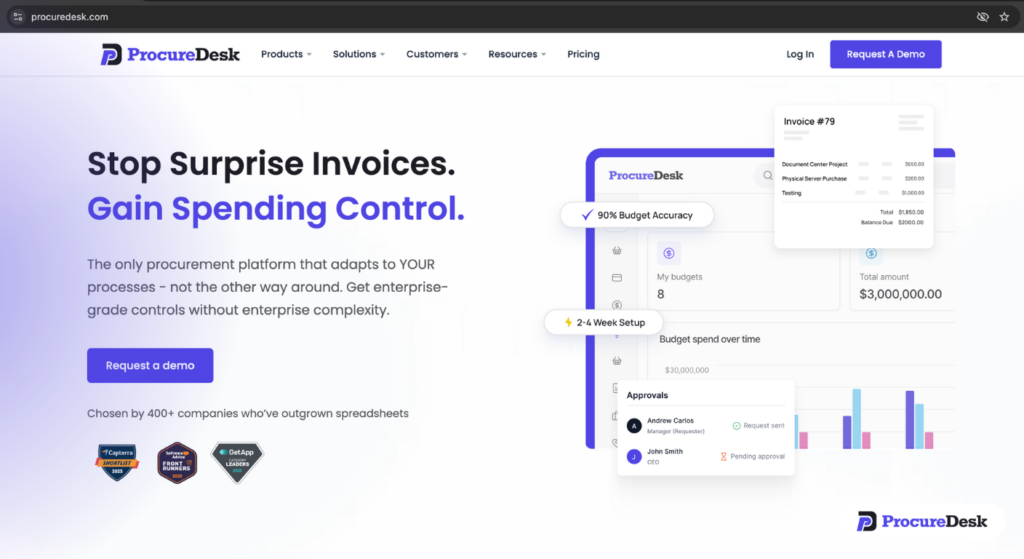
Table of Contents
Why Cincinnati finance teams are evaluating procurement software in 2026
Cincinnati runs on the kind of companies that buy a lot, from a lot of vendors. The region anchors one of the most demanding consumer goods supply chains in the country. Procter and Gamble’s global headquarters and Kroger’s procurement operation sit here, alongside a dense network of CPG suppliers, logistics firms, and distributors. Around that core sits a deep base of mid-market manufacturers, biotech and life-science companies, and professional services firms.
That buying volume is where manual purchasing breaks. A company grows from 80 to 300 people. Purchase requests start arriving by email, Slack, and hallway conversation. The controller loses the thread. Spend happens first and gets recorded later.
The 2026 backdrop makes it urgent. In Deloitte’s Q1 2026 CFO Signals survey, 52% of finance chiefs named cost management their most worrisome internal concern. That was the top response, up from 47% and third place six months earlier. The quarter before, 50% of CFOs put digital transformation of finance at the top of their 2026 priorities, with cash management optimization right behind it. The same survey found 49% planning to automate processes so staff can do higher-value work, rather than add headcount.
What procurement software actually covers
Buyers use a few terms loosely, so it helps to be precise. Procurement software, AP automation, and procure-to-pay overlap, but they are not the same.
- Procurement (or purchasing) software manages the front end: purchase requests, approval routing, purchase orders, and vendor catalogs.
- AP automation manages the back end: invoice capture, matching, and the approval that clears an invoice for payment.
- Procure-to-pay (P2P) covers the full path, request through payment, in one system.
The distinction decides your shortlist. If purchases happen without an approved PO, AP automation alone will not fix it. The exception lands in your AP queue anyway. You need procure-to-pay, which controls the purchase before it becomes an invoice.
How to evaluate procurement software: 6 criteria for mid-market finance teams
Use these six criteria to judge any tool on your shortlist. They are ordered by how often they decide the outcome for finance teams at your size.
- Pre-invoice control. Does the tool capture and approve a purchase before the commitment, or only after the invoice arrives? Control before the spend is the point.
- 3-way matching. Can it match the purchase order, the goods receipt, and the invoice automatically, then flag only the exceptions? This is what removes manual reconciliation at close.
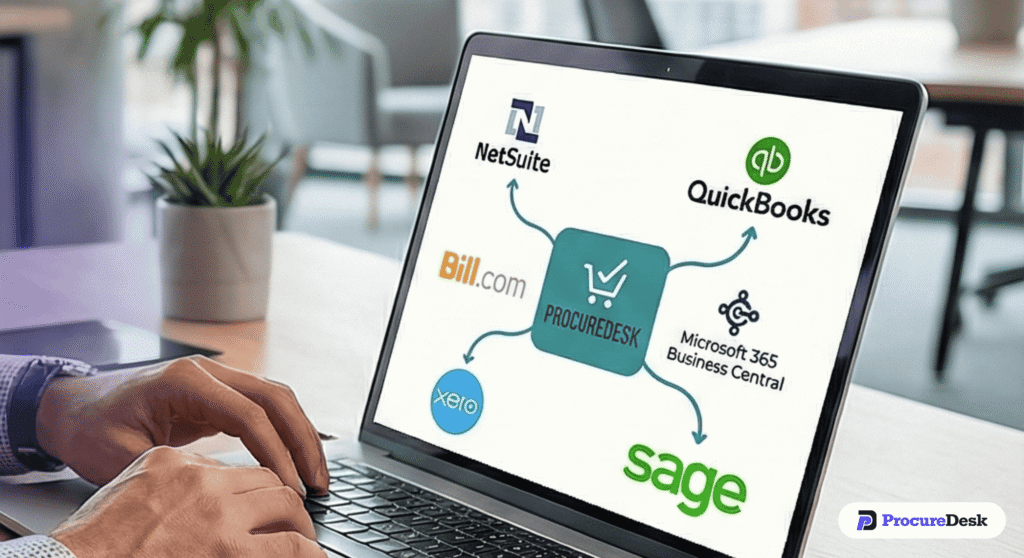
- Accounting integration. Does it sync both directions with your system, whether that is QuickBooks, Sage Intacct, NetSuite, Microsoft Business Central, or Xero? A one-way export is not an integration.
- Punchout catalogs. Can your team order from real suppliers inside the tool, with budget checks and approval built in? This matters for any company buying physical goods.
- Approval routing. Can you build multi-level approval rules by amount, department, and budget without a developer? Rigid approval logic is a common reason teams abandon a tool.
Implementation reality. How long until you are live, and who does the setup work? A six-month deployment is a different decision than a three-week one.
Start hereScore your current state firstBefore you shortlist anything, see where spend escapes control today. It takes about five minutes.Run the Spend Control Readiness Scorecard →
Why manual purchasing costs Cincinnati finance teams more than they think
The hidden cost is in slow, manual processing. Ardent Partners’ 2025 benchmarks put the average cost to process one invoice at $12.88, against $2.88 for the top performers. Average processing time runs 17.4 days, versus 3.1 days for the best. Most of that gap starts upstream, when a request gets approved over email and no formal PO is created. When the PO is missing, the match fails, the invoice routes to manual review, and the payment slips. Late payments can carry penalties. Email approvals also leave an audit gap, because the record lives in someone’s inbox instead of a system.
You can put real numbers on your own process with the ROI calculator. The gap widens as you grow. APQC research shows a manual AP team handles roughly 6,500 invoices per person each year, while a fully automated team handles more than 20,000. When purchase volume jumps during a growth phase, a manual process needs proportional headcount just to keep pace.
In our onboarding work with 300+ mid-market finance teams, the pattern is consistent. The problem is almost never a lack of effort from the AP team. The company outgrew a manual process, and no system was capturing purchases at the point of request. Close that gap and the surprise invoices stop. ProcureDesk customers report up to 90% fewer invoices arriving without a PO.
Live walkthrough · about 20 minSee it run on your workflowA real approval and a live 3-way match against your scenario, not a generic tour.Request a demo
Where the tools sit in the market
The procurement market has clear tiers, and matching your size to the right tier saves months. We will name names so you are not comparing across the wrong row.
Mid-market (100 to 1,000 employees). This is the tier most Cincinnati finance teams belong in. ProcureDesk, Procurify, and Precoro all play here. Pricing sits close together at the entry point. Precoro starts around $499 a month, and ProcureDesk starts at $498 a month billed annually. ProcureDesk’s edge is stronger 3-way matching and deeper QuickBooks support, including Desktop and Enterprise, not only Online. Procurify optimizes for the requester experience across the whole company. ProcureDesk optimizes for the controller and financial accuracy.
Enterprise (1,000+ employees). Coupa and SAP Ariba serve the Fortune 500, with implementations measured in quarters and quote-based pricing. If you are under 1,000 people, this is what you would use if you were much larger, not what fits you now.
Card-first tools. Ramp and Brex manage spend after the card is swiped. They do not issue purchase orders, confirm goods receipt, or run 3-way matching, and they do not support punchout catalogs. For a company buying physical goods from established vendors, a card alone leaves a gap.
The point is not that one tier is better. It is that buying out of tier costs you either money or capability.
ProcureDesk: procurement and AP automation built for mid-market finance teams
After implementing ProcureDesk, a controller stops chasing approvals and stops finding invoices with no PO behind them. Spend is visible the moment it is requested, not three weeks later at close. That is the change finance teams feel first.
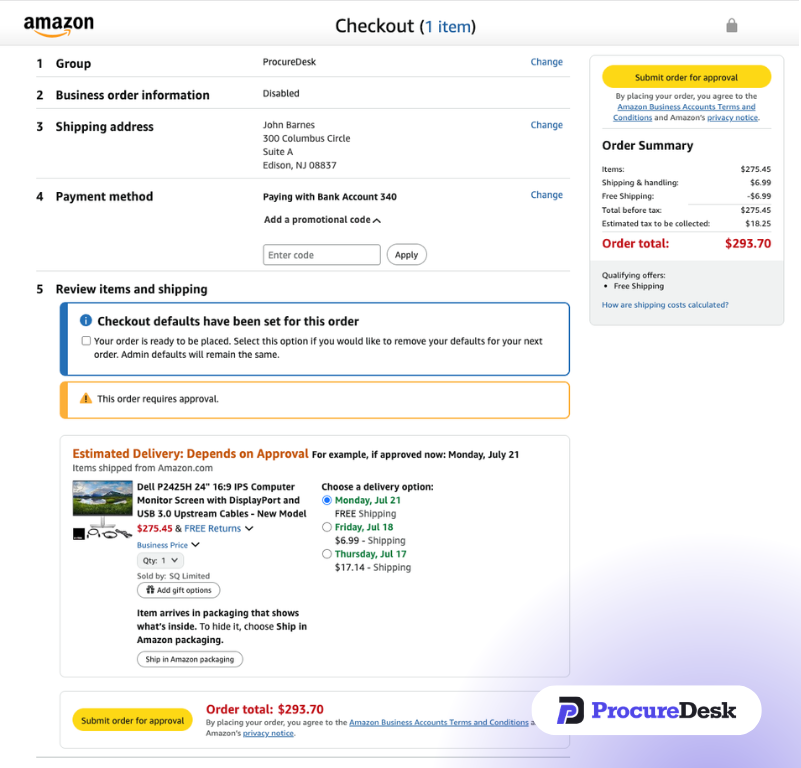
ProcureDesk is built for companies with 100 to 1,000 employees that process more than 100 invoices a month. It connects to 200+ punchout supplier catalogs, including Amazon Business, Grainger, Staples, Thermo Fisher, and McMaster-Carr. Your team orders from approved vendors with budget checks and approval routing already built in. It runs the full procure-to-pay path in one system. That path covers request, approval, purchase order, goods receipt, automated 3-way matching, and a two-way sync with your accounting software.
The ICP math is the reason it fits. Purchasing happens across 10, 20, or 50 people, but the finance team managing all of it is 1 to 3 people. A few capabilities carry most of the weight:
- Automated 3-way matching with tolerance settings. The PO, receipt, and invoice match on their own. Only the exceptions reach a human, which is what cuts reconciliation time at month-end.
- QuickBooks Desktop and Enterprise support. Most competitors integrate only with QuickBooks Online. Many Cincinnati manufacturers and distributors still run Desktop or Enterprise, and ProcureDesk syncs with both.
- ERP flexibility without a rebuild. A company that starts on QuickBooks and moves to NetSuite in two years keeps the procurement layer in place. The integration is API-based in both directions.
- Done-for-you setup. ProcureDesk configures your purchasing rules, approval workflows, integrations, and catalogs. Your finance team is not handed a blank platform to build.
The proof shows up in customer results. Funai Lexington, a manufacturer running QuickBooks, cut invoice processing time by 46% and gave back about 30 hours a month to its finance team. Coast Flight reduced invoice processing time by 30%. These are mid-market finance teams that look a lot like the ones across the Cincinnati metro.
Pricing is published, not hidden. Purchasing Automation starts at $498 a month billed annually. The full Purchasing and AP Automation plan starts at $850 a month billed annually. Both include 10 users.
Live 3-way matchReady to see your numbers?POReceiptInvoiceMatchedRequest a demo
How long does procurement software take to implement?
For a mid-market finance team, expect 2 to 4 weeks with ProcureDesk, not the multi-month projects enterprise suites require. ProcureDesk handles the full setup, including your approval rules, accounting integration, and supplier catalogs. There is no IT project and no internal build, which is why most teams are live inside a month.
Does procurement software replace QuickBooks?
No. ProcureDesk works alongside QuickBooks rather than replacing it. It adds the procurement and approval layer that QuickBooks does not have, then syncs purchase orders, receipts, and matched invoices back into your accounting system. Your books stay in QuickBooks. The control happens before the entry.
Is ProcureDesk only for Cincinnati companies?
No. ProcureDesk is headquartered in Cincinnati and works with mid-market finance teams across the United States, Canada, and the UK. The local roots matter for one reason. The team that built it understands the manufacturing, distribution, and professional services mix that defines this region’s mid-market.
How to get started
Moving to procurement software is a smaller project than most finance leaders expect. Here is the practical path.
- Score your current state. Run the readiness scorecard to see where spend escapes control today.
- Map your accounting system. Confirm whether you are on QuickBooks Desktop, Enterprise, Online, Sage Intacct, NetSuite, Business Central, or Xero, then check integration depth on your shortlist.
- Shortlist in your tier. Compare ProcureDesk, Procurify, and Precoro. Leave the enterprise suites and card-first tools off unless your situation truly calls for them.
- See it on your data. Book a walkthrough and watch a real approval and match run, not a generic demo.
With done-for-you setup, a Cincinnati finance team can be live in 2 to 4 weeks, with spend under control before the next quarter closes.
Readiness check · about 5 minNot ready to shortlist yet?ApprovalsPO coverage3-way matchFind the gapsStart the scorecard
Read a summarized version with:
Frequently Asked Questions About Procurement Software
What is the difference between procurement software and AP automation software?
Procurement software manages the front of the buying process: purchase requests, approval routing, purchase orders, and vendor catalogs. AP automation manages the back: invoice capture, matching, and payment approval. Procure-to-pay platforms like ProcureDesk run both in one system. A purchase is approved before it becomes an invoice, so the invoice already has a PO to match against.
How much does procurement software cost for a mid-market company?
Most mid-market procurement and AP automation platforms run from a few hundred to a few thousand dollars a month, priced by users or transaction volume. ProcureDesk starts at $498 a month billed annually for Purchasing Automation, or $850 for the full Purchasing and AP Automation plan, both including 10 users. Always weigh the price against the cost of manual processing.
What is 3-way matching and why does it matter?
Three-way matching compares the purchase order, the goods receipt, and the vendor invoice before a payment is approved. It catches price and quantity discrepancies before money goes out the door. Automated 3-way matching, like ProcureDesk runs, clears the clean invoices on its own and routes only the exceptions to a person. That removes most manual reconciliation at month-end close.
Does procurement software work with QuickBooks Desktop and Enterprise?
Some does, but many tools integrate only with QuickBooks Online. ProcureDesk syncs with QuickBooks Online, Desktop, and Enterprise, along with Sage Intacct, NetSuite, Microsoft Business Central, and Xero. The sync runs both directions, so purchase orders, receipts, and matched invoices flow back into your books automatically. This matters for the many mid-market manufacturers and distributors still running Desktop or Enterprise.
What size company needs procurement software?
Procurement software earns its place when purchasing outgrows email and spreadsheets. That usually happens at companies with 100 to 1,000 employees processing more than 100 invoices a month. At that scale, purchasing happens across dozens of people while a 1 to 3 person finance team tries to control it. ProcureDesk is built for that mid-market gap, between basic tools and enterprise suites.
How do you stop invoices from arriving without a purchase order?
You move the control upstream, to the moment of request. When every purchase starts as an approved request that generates a PO, the invoice arrives with a PO already attached and matches automatically. Email approvals do not do this, because no formal PO is created. In our onboarding work with mid-market finance teams, this shift drives up to 90% fewer invoices arriving without a PO.
What is the best procurement software for Cincinnati mid-market finance teams?
The best fit depends on your accounting system and invoice volume. Mid-market finance teams should compare ProcureDesk, Procurify, and Precoro before enterprise suites or card-first tools. ProcureDesk is headquartered in Cincinnati, supports the QuickBooks versions common across the region, and runs full procure-to-pay with done-for-you setup in 2 to 4 weeks. Book a demo to see it on your workflow.
The bottom line for Cincinnati finance teams
Say you run finance at a Cincinnati-area company between 100 and 1,000 employees. If invoices keep arriving without POs while close drags into week two, you have outgrown manual purchasing. Procurement software fixes the sequence by putting control before the spend, not after it. ProcureDesk is built for finance teams your size, supports the QuickBooks versions this region actually runs, and is headquartered right here.
20MINThe 20-minute testIf you process more than 100 invoices a month, ProcureDesk is worth 20 minutes of your time.Request a demoSee it run on your workflow