An invoice approval threshold is the dollar amount above which an invoice needs sign-off before payment. Set thresholds too low and your CFO approves staplers. Set them too high and a $40,000 surprise lands in the ledger unreviewed.
This guide gives you a starting approval matrix by company size, a delegation of authority structure to back it, and a routing rule for the invoices that arrive without a PO.
It is written for Controllers and Accounting Managers at companies with 100 to 1,000 employees, where invoice volume has outgrown a one-person approval bottleneck but a formal policy never got written.
Most articles on this topic define the terms and stop. This one gives you numbers to start from.
Approvals living in your inbox? See how a tiered approval matrix runs itself, with every invoice routed to the right approver automatically.
Request a demo →Table of Contents
What Is an Invoice Approval Threshold?
An invoice approval threshold is a dollar limit that determines who must approve an invoice, or the purchase behind it, before payment. Below the threshold, the invoice is auto-approved or approved by a manager. Above it, the approval escalates: department head, Controller, CFO, and at the top, the board.
Thresholds do two jobs at once. They protect the company from unreviewed spending, and they protect senior approvers from drowning in small approvals that do not need their judgment.
What Is an Approval Matrix?
An approval matrix is the table that maps dollar ranges to required approvers. It answers one question for any invoice: who needs to sign off on this amount, in what order? A good matrix fits on half a page. If yours needs a legend to read, it will not survive contact with a busy week.
The matrix is the policy. The invoice approval workflow is the policy in motion: the actual routing, reminders, and escalation that move an invoice through the matrix.
Approval Thresholds by Company Size: A Starting Matrix
There is no regulation that sets these numbers. But across our onboarding work with 200+ mid-market companies, the workable starting points cluster by company size. Use these as a first draft and adjust to your spend profile and risk tolerance:
Approval matrix
100 to 250 employees
Approval matrix
250 to 500 employees
Approval matrix
500 to 1,000 employees
Three notes on using these tables.
First, the auto-approve tier only works when the invoice matches an approved PO; an unmatched invoice should never auto-approve at any amount.
Second, the right thresholds depend on your margins: a $5M services firm and a $250M manufacturer should not share a matrix.
Third, review the matrix annually and confirm it with your auditor; thresholds are an internal control, and your audit will test whether you follow your own policy.
Delegation of Authority: Turning the Matrix Into Policy
A delegation of authority (DoA) matrix is the formal version of the table above. It documents who holds approval authority at each level, what happens when they are unavailable, and who granted the authority in the first place. Auditors ask for it by name.
A workable DoA policy for a mid-market company covers four things:
- Named roles, not named people. Authority belongs to “the Controller,” not to Maria. People leave; roles stay.
- Delegation rules. When an approver is out, authority passes to a named alternate at the same level or higher, never downward. Time-box it: delegation that outlives the vacation becomes a control gap.
- No self-approval. Nobody approves their own purchase or an invoice from a vendor they manage. This is the single rule auditors check first.
- An escalation clock. If an invoice sits unapproved for a defined period (48 to 72 hours is common), it escalates automatically rather than aging into a late fee.
Write the DoA once, get it signed by the CFO, and let your system enforce it. A policy that lives in a PDF and depends on memory is a policy your audit will flag.
Free template
Skip the blank spreadsheet
Download the Approval Matrix & Delegation of Authority Template.
Get the template →How Should Non-PO Invoices Be Approved?
A non-PO invoice arrives with no purchase order behind it, so there is nothing to match it against. Utilities, rent, subscriptions, and one-off services are the usual sources. The routing rule that works: send every non-PO invoice to the person who owns the vendor relationship for first approval, then apply the same dollar thresholds from your matrix on top.
Two guardrails make this manageable. Keep an approved list of vendor categories that are allowed to bill without a PO (rent, utilities, taxes), and treat everything else as a process failure to fix upstream.
Our customers see this directly: requiring a PO before purchase is how teams cut surprise invoices, which is why purchase order approvals and invoice thresholds belong in one connected policy.
Common Threshold Mistakes
We see the same four mistakes in companies moving off email approvals:
- One threshold for everything. A flat “$1,000 needs approval” rule ignores that a $900 software subscription and a $900 lab reagent carry different risks. Use the matrix, and where needed, vary by category.
- The CFO as approver of everything. If one person approves more than 30 to 40 invoices a week, approvals become rubber stamps. That defeats the control entirely.
- Thresholds without enforcement. A policy in a shared drive does not stop a payment. Only a system that blocks payment until the matrix is satisfied does. This is where approval workflow best practices earn their keep.
- Never revisiting the numbers. A matrix set at 100 employees strangles a 400-employee company. Review it when headcount doubles or annually, whichever comes first.
Enforcing Thresholds Automatically With ProcureDesk
After implementation, the matrix you wrote above runs itself. A request or invoice enters ProcureDesk, the system reads the amount, department, and budget, and routes it to exactly the approvers your delegation of authority names, in order, with escalation timers running.
ProcureDesk is a procurement and AP automation platform built for mid-market finance teams at companies with 100 to 1,000 employees.
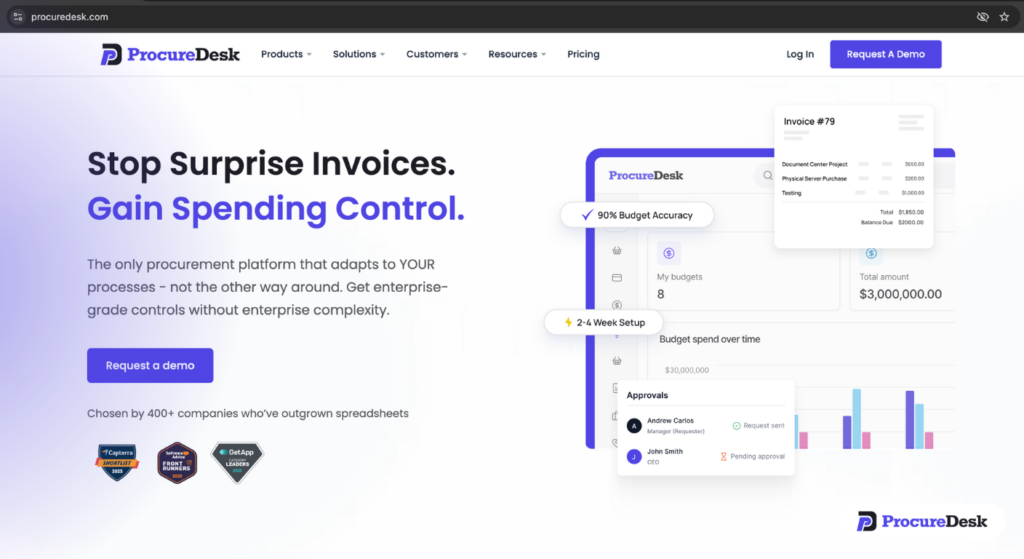
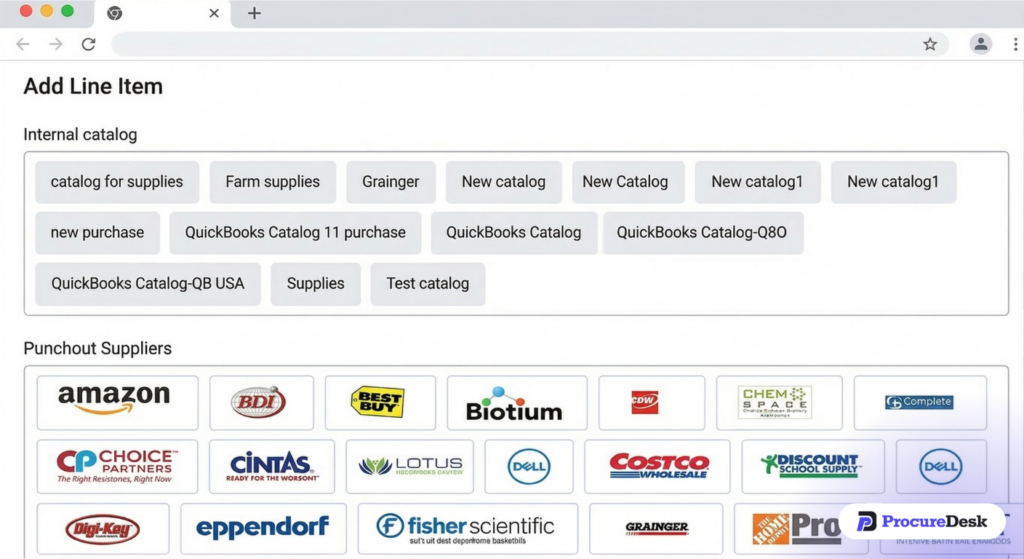
Spending is captured at the point of request, before the invoice exists: employees buy through 200+ punchout supplier catalogs, including Amazon Business, Staples, Grainger, and Thermo Fisher, so every purchase arrives pre-coded and pre-approved against your thresholds. Bill.com sits after the invoice; ProcureDesk sits before, so the threshold is enforced when a purchase is requested, not after the money is committed.
What that changes for a Controller:
- Self-approval limits work without policing. Purchases under your auto-approve tier flow through with a PO match; everything above routes per the matrix, with a full audit trail on every step.
- 3-way matching guards the bottom tier. Auto-approval only fires when PO, receipt, and invoice agree. Discrepancies are flagged before payment, not found at month-end.
- Your accounting system stays. ProcureDesk syncs both ways with QuickBooks (Online, Desktop, and Enterprise), Sage Intacct, NetSuite, and Microsoft Business Central.
Coast Flight cut invoice processing time by 30% after moving approvals into ProcureDesk. Implementation is done for you in 2 to 4 weeks, with pricing published here.
Want your matrix enforced, not just written?
Request a demo →Frequently asked questions
Invoice approval thresholds
What is a good invoice approval threshold?+
For a company with 100 to 250 employees, a common starting point is: auto-approve under $500 with a PO match, manager approval to $5,000, Controller approval to $25,000, and CFO approval above that. Scale the tiers up as headcount and average invoice size grow.
Who should approve invoices in a company?+
The person with budget ownership for the spend, at the level your approval matrix assigns to that dollar amount. Below the threshold, a department manager; above it, the Controller or CFO. The exception list is short: never your own purchases, never a vendor relationship you own.
What is the difference between an approval matrix and a delegation of authority?+
The approval matrix is the table mapping dollar ranges to approvers. The delegation of authority is the formal policy behind it: who holds the authority, who they can delegate to when unavailable, and who authorized the structure. Auditors review the DoA; employees use the matrix.
How do you approve invoices without a purchase order?+
Send them to whoever owns the vendor relationship for a first check, then run them through the same dollar tiers as PO-backed invoices. Keep the no-PO list short and pre-approved; anything arriving outside it should trigger a PO requirement for that vendor going forward.
Should small invoices be approved automatically?+
Yes, if and only if they match an approved purchase order. Auto-approving unmatched invoices at any amount removes the control entirely. With PO matching in place, auto-approval below a defined tier saves senior approvers hours each week without losing oversight.
The Bottom Line
Approval thresholds are the cheapest internal control you can deploy: a half-page matrix, a signed delegation of authority, and a routing rule for non-PO invoices. Start from the free Approval Matrix & Delegation of Authority Template, adjust the tables to your spend profile, and confirm them with your auditor.
Then make them enforceable. If your approvals still travel by email, the policy exists only as good intentions. ProcureDesk enforces your matrix on every request and invoice, live in 2 to 4 weeks.
Bring your approval policy. We will show you what it looks like running on autopilot.
Request a demo →